
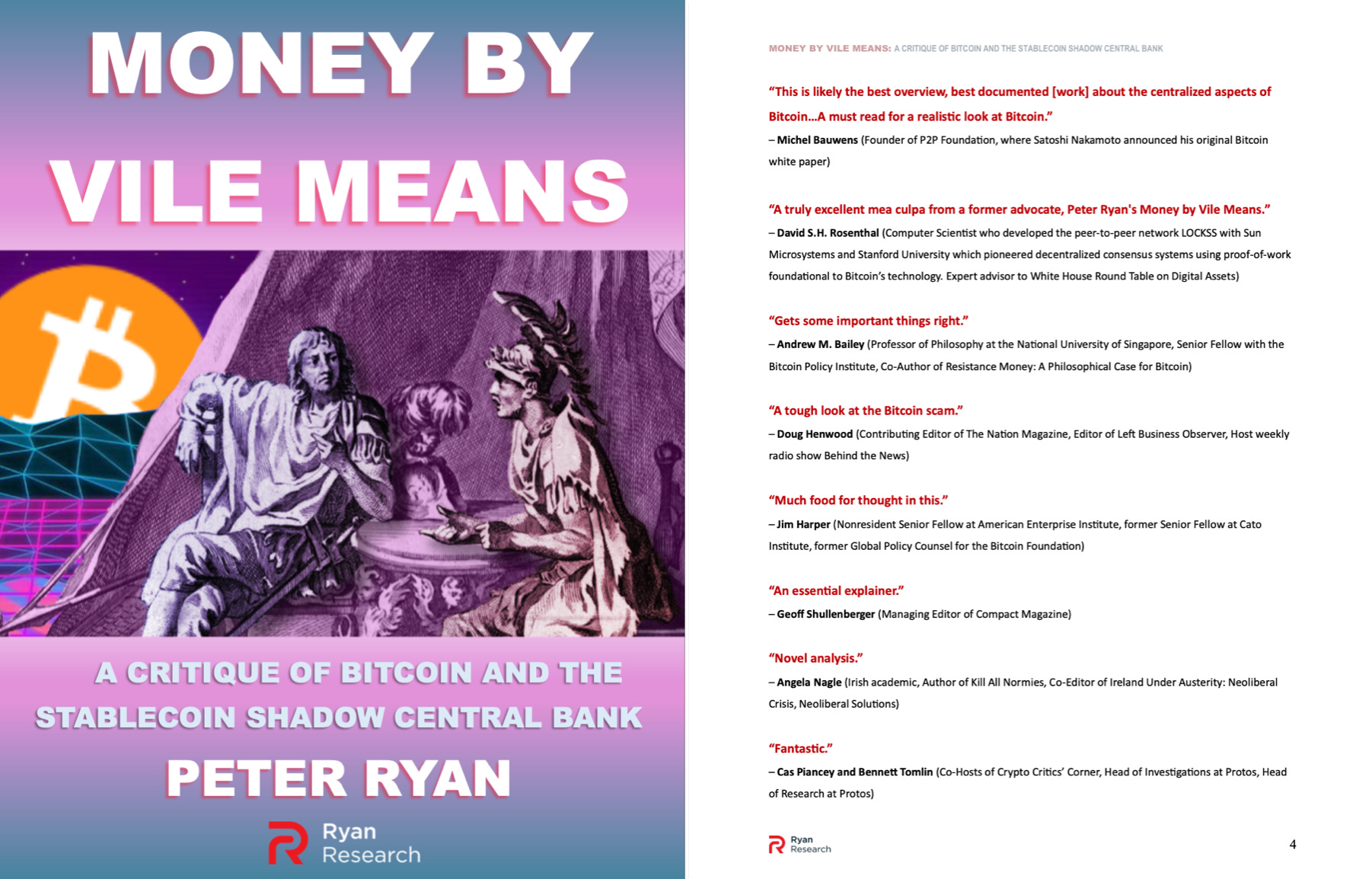
Money by Vile Means
A Critique of Bitcoin and the Stablecoin Shadow Central Bank

“For I can raise no money by vile means. By heaven, I had rather coin my heart and drop my blood for drachmas than to wring from the hard hands of peasants their vile trash by any indirection.” Brutus said this in Act IV, Scene III of Shakespeare’s Julius Caesar. He felt no qualms about his request for gold from Cassius but was distraught at being asked to use Cassius’ same methods to raise gold directly for himself. He was confronted with the clash between his ideals and the truth of his conspiracy. Brutus might be able to craft a narrative that his conspiracy was honorable, but the actual unfolding of events proved to be the opposite. Cassius’ conniving corruption was the dark reality behind the honorable mask of Brutus’ virtuous ideals. In truth, there was no means besides those that were vile to raise the money Brutus needed. Just as there was no means other than those vile to act out their plot. Brutus couldn’t accept that his conspiracy was of and begot corruption rather than idealism.
Bitcoin is money by vile means. In the same way that Brutus used noble rhetoric to shroud the vileness of his conspiracy, Bitcoin zealots used analogous rhetoric to portray their movement. As a reaction to financial corruption and tyranny of institutional Caesarism of the government’s fiat money system, Bitcoiners promised a just restoration of order by overthrowing that system. History revealed that promise to be just as illegitimate as Cassius’.
Bitcoin’s founding goal of fighting unconstrained government spending produced by fiat currency has been inverted, as crypto is increasingly serving as a means of enabling more deficit spending and preservation of US’ fiat currency, an agenda the Trump administration has all but explicitly embraced. Today, crypto is merely the latest ruse to persuade the public to surrender democratic freedom and financial sovereignty to oligarchs.
The Crash That Birthed Digital Cash
The story of Bitcoin begins with a simple question. Where does money come from? This question encapsulated the trends that burst forth in 2008’s Global Financial Crisis. Money was plentiful, and then it wasn’t. Why? The world changed. Economics took over the zeitgeist. A wonkish 1970s TV show called “Free to Choose” went viral on YouTube, American expats were selling bars of gold to protect from THE collapse, and somehow guys with bowties talking about Austrian economics became cool. Well maybe not cool but noticeable.
Austrian economics is a school of thought that promotes extreme freedom of the private sector and extreme restriction of the public sector. Their answer to the prior question is that money comes from nature. Money, they say, is some form of scarce commodity, like gold, and the decentralized market decides which scarce commodity shall be used as money. Thus, government centralized printing of money artificially corrupts nature. They analyzed the Global Financial Crisis as the outcome of such artificial and centralized corruption.
Google Trends data showed “Austrian economics” reached its all-time-high in February of 2009, it’s second all-time-high in January of 2012. This intense period Austrian economics popularization served as an incubator for Bitcoin. Bitcoin was created in 2008 by the anonymous Satoshi Nakamoto. He led the development of the project until 2011 when he mysteriously disappeared. From forum posts, it’s clear Nakamoto was a follower of Austrian economic theories on gold. Bitcoin’s most cherished feature is its 21 million coin finite supply which emulates the scarcity of gold. Bitcoin’s Google Trends data followed a similar path to that of Austrian economics. It was the culmination of years of open-source software development that fused with Austrian economics.
In his 2017 book, How Money Got Free, Brian Patrick Eha, wrote, “Bitcoin started: on the fringe, where great ideas are usually born, among radical minds willing to embrace a radical invention. For them, economics was not a dry subject to be taught in universities. It was an animating force, a key to understanding human action. To them technology did not mean merely building a better mousetrap. It meant building a better world.”
The early Bitcoin community grew by attracting idealist libertarians. It wasn’t sold as a get quick rich scheme back then. It was evangelized as a political revolution to purify the world. It’s not hyperbole to describe things so grandiose. One of the most famous early Bitcoiners, Roger Ver, was literally nicknamed Bitcoin Jesus for his idealistic evangelism of Bitcoin as a means to achieve Austrian economic ends. Ver said, “Price is the least interesting thing about bitcoin…At first, almost everyone who got involved did so for philosophical reasons. We saw bitcoin as a great idea, as a way to separate money from the state.” Similarly Ver said, “I’m motivated by the positive ways in which Bitcoin use being widespread will make the world a better place.” Ver and his disciples are the analogue to the idealist Brutus.
The Bitcoiners created a noble narrative for Bitcoin. They saw Bitcoin’s finite supply as a solution to central bank money printing that could restore economic order. Bitcoin’s finite supply was secured by decentralization. They extrapolated the anarchic market theory of Austrian economics to the concept of Bitcoin decentralization. In short, the more decentralization the better. Bitcoin, allegedly, couldn’t be centralized because there was always a vast ocean of market actors dissolving any hierarchical structure. This way no central authority could change the software to alter the finite supply.
This gave way to the two big myths of Bitcoin. One, the software is decentralized. Two, the market is decentralized. Together these two myths form the conclusion that, because the software and market are decentralized, Bitcoin serves the noble ideological ends and doesn’t serve the interests of nefarious actors, especially the behemoth American state. But each myth, is just that — a myth.
Myth 1: The Software is Decentralized
Bitcoin is not like gold. You can’t dig it out of the ground. Whatever similarities are claimed to be between Bitcoin and gold, a basic fact first must be acknowledged. Bitcoin is a byproduct of software. Software is written by humans. Code needs to be updated by humans. Who are these humans?
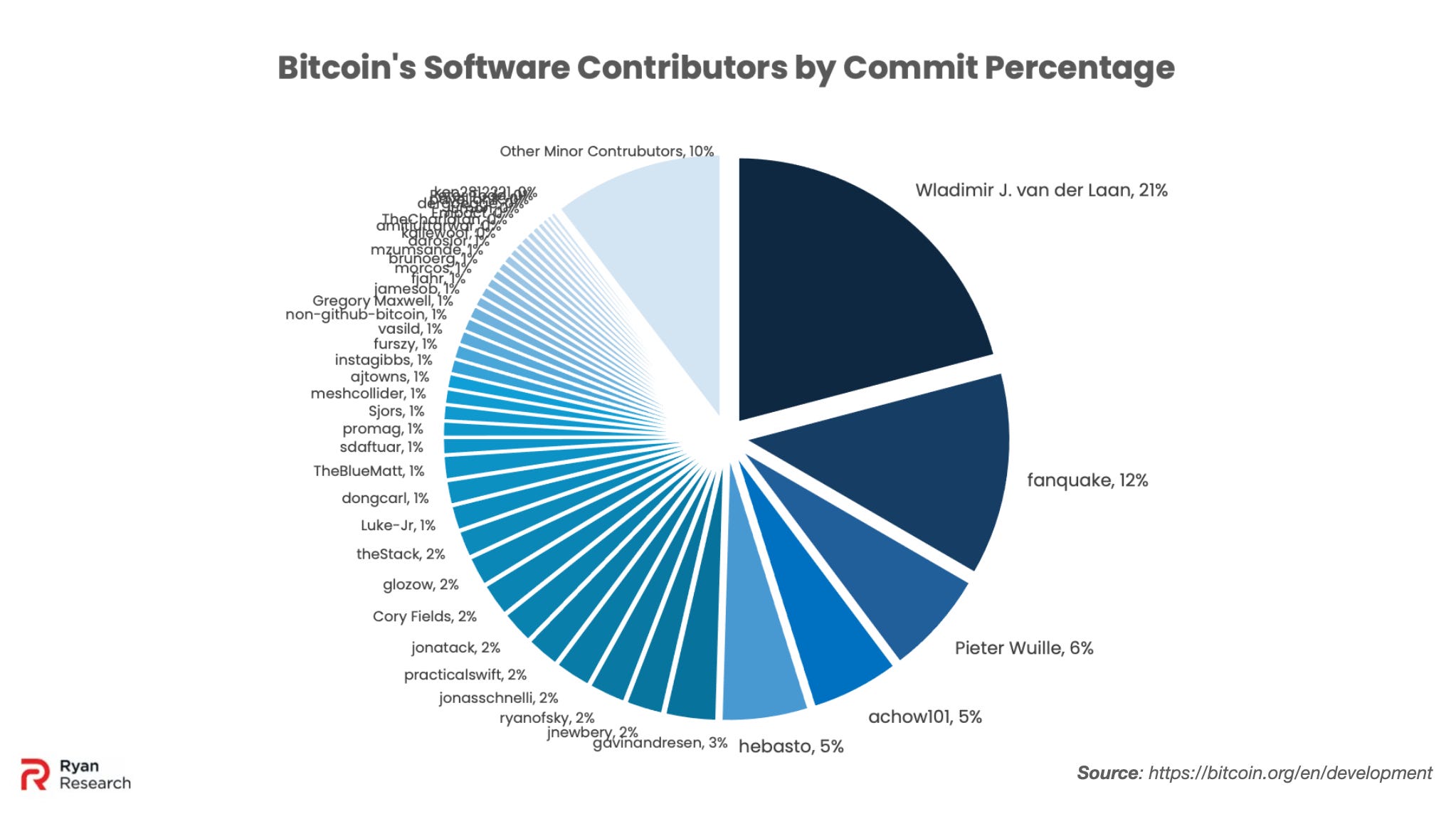
As touched upon earlier, Satoshi Nakamoto created Bitcoin. At one point, all of Bitcoin’s software was centralized under his control. Over time that control of the code expanded but not by much. According to the Bitcoin official website, 346 individuals contributed to Bitcoin’s software. However, only 5 individuals were responsible for over 50% of the code. Further, 20 individuals were responsible for over 75 percent and 42 individuals for 90 percent. While there is a long-tail of hundreds of marginal one-off contributors, it is remarkable that most of the code is centralized around just under 50 people.
This has been a preview. To continue reading the full version and download the eBook (PDF format), please become a paid subscriber to Ryan Research.