Ireland's Tech Fork in the Road
Economic Structures Shape Political Interests

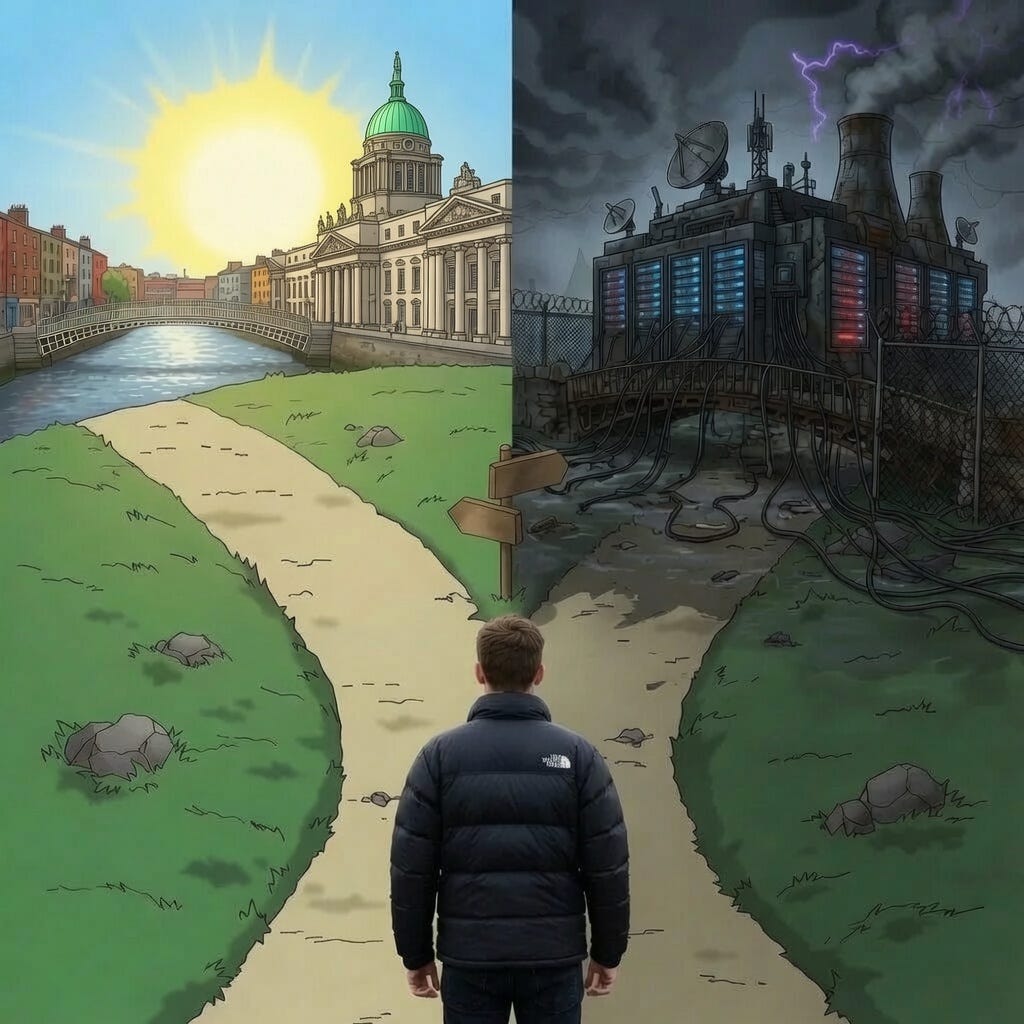
Ireland stands at a tech fork in the road: double down on its reliance on American tech giants, or begin the difficult shift towards European tech sovereignty. One well-trodden path leads to dependence and distortion. The other calls for radical change but points towards independence and development. Ireland’s choice will determine the success or failure of businesses across the country and the very character of its politics.
Ireland is not aware of the second order consequences of its reliance on the American tech sector. As American tech becomes more ideological and bound up in the American government’s strategic political interests, American tech will become more divergent from Irish and European strategic political interests. The more American tech structures expand in and weave throughout Ireland, the more incentives are made for Irish policy makers to coalesce in favor of American political interests.
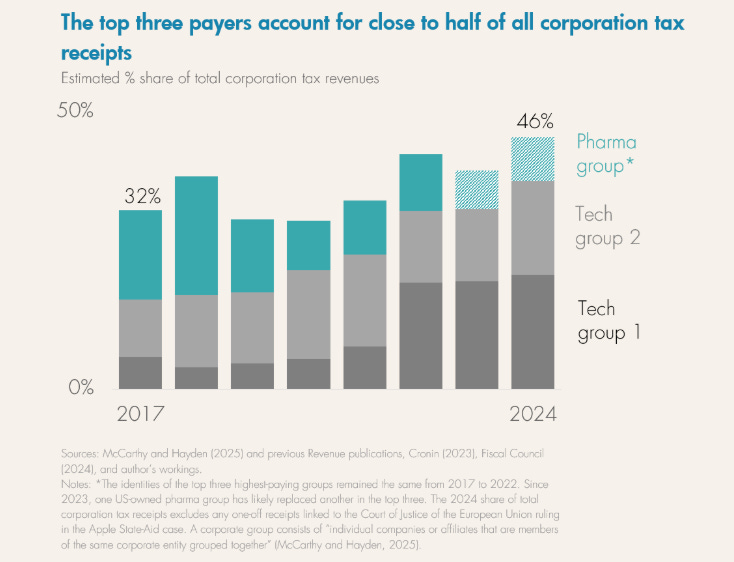
These structures create dependencies for investment, jobs, and tax revenue as well as sunk costs and frictions that make change hard to imagine and actualize. American companies employ 190,000 employees in Ireland, support 152,000 jobs indirectly, invest €6.5 billion annually on capital expenditure, and €8.8 billion on goods and services, according to the American Chamber of Commerce Ireland. The Irish Times reported that Ireland collected €34.7 billion in corporation tax in 2025. As the Irish Fiscal Advisory Council highlighted almost half of Irish corporation tax revenue comes from just a few American firms. The Irish government faces a real hard constraint that can’t be easily dismissed. There are severe economic repercussions for disrupting these relationships. The dominant policy-makers are not lying when they discuss the “benefits” from this system and “risks” of disturbing it. The hard constraint is what produces the contradiction of supporting American interests over Irish and European ones.
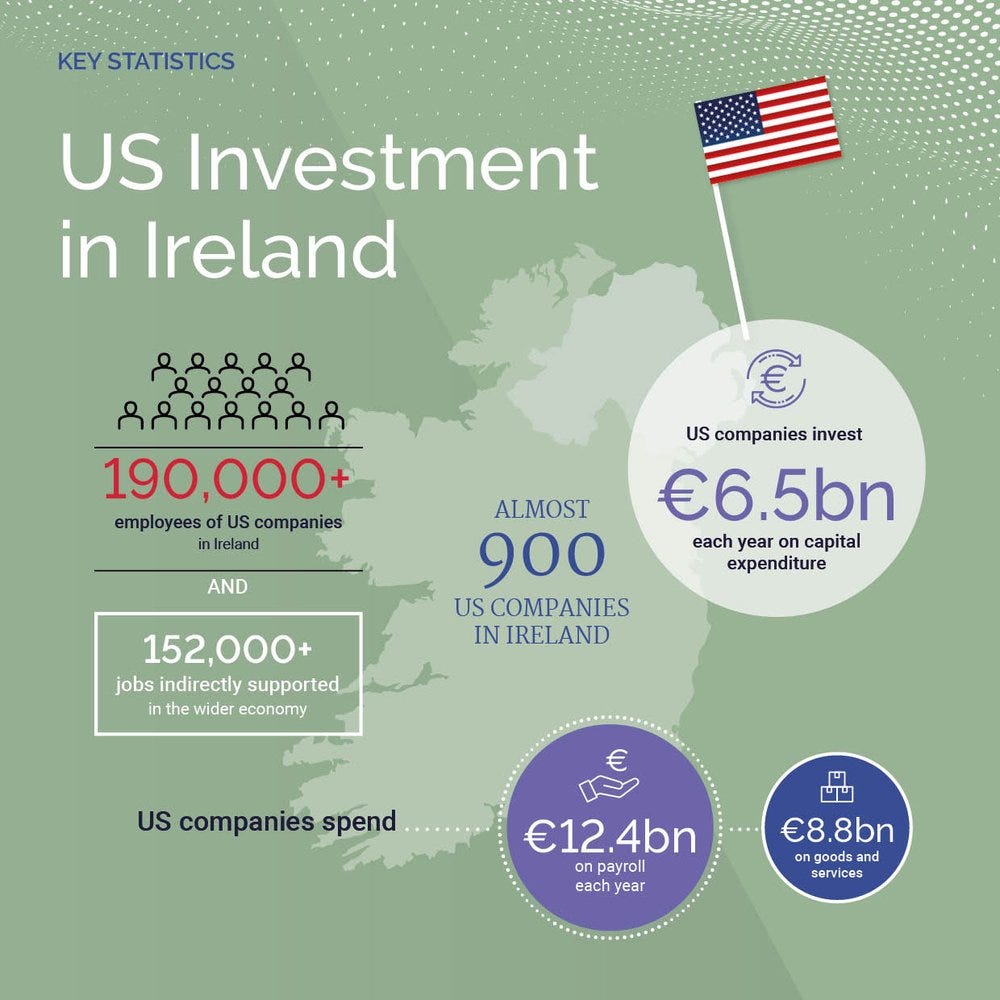
The key insight here is that you cannot divorce economics from politics. Economic structures envelope geography and people into a political paradigm. Ireland chose to become an appendage of American economic structures. Ireland is not a “transatlantic economic bridge” because that implies a two-way street with European companies in Ireland doing business with America. The dominant relationships concern the one-way street of American firms doing business with Europe.
Ireland’s economic success depends on the maintenance and expansion of American economic presence in Europe. However, in the multipolar era, this becomes problematic. Europe is increasingly seeing itself threatened by the large superpowers of America and China. Europe’s decentralized and fragmented status, in the face of this, is producing conversations around how to fix it. One of Europe’s key vulnerabilities is its lack of tech sector dominance relative to American tech which eats up a large market share inside Europe. One group of pro-sovereignty Europeans wants to actively build a domestic tech sector to compete with America and China.
The EuroStack
This group’s vision is called the EuroStack, defined as: “a European Industrial Policy initiative bringing together tech, governance and funding for Europe-focused investment to build and adopt a suite of digital infrastructures: from connectivity to cloud computing, AI and digital platforms.”
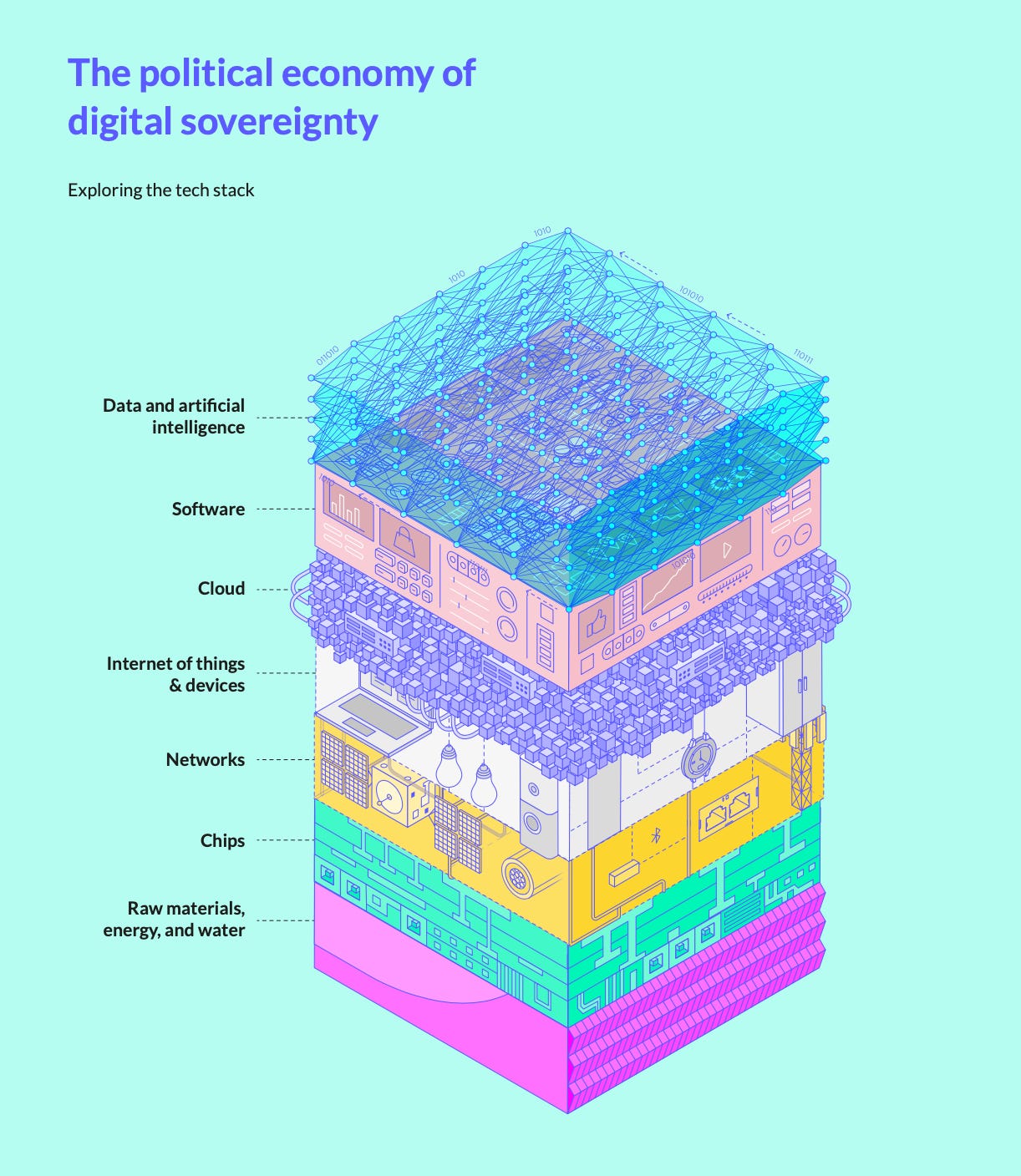
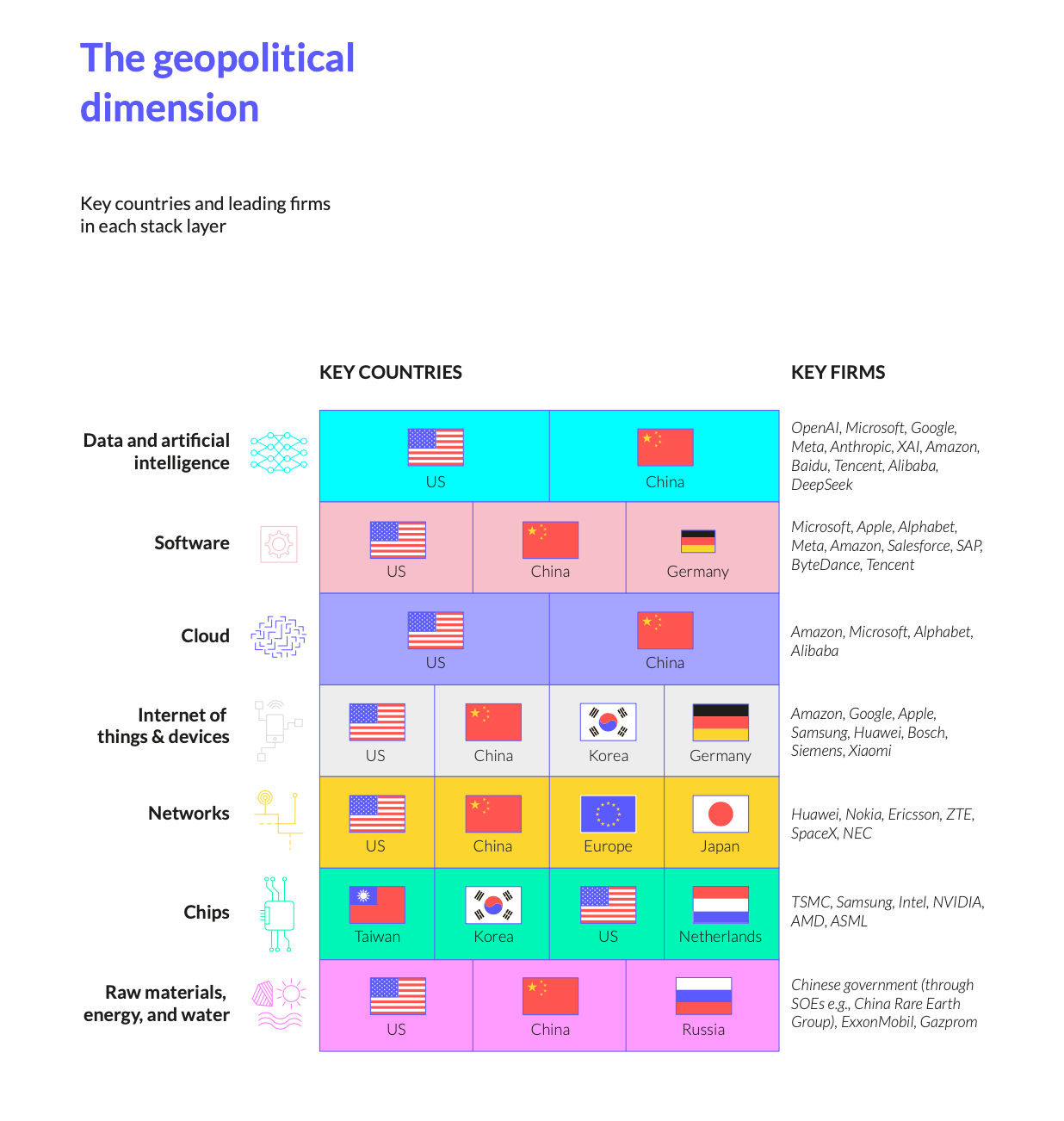
The EuroStack group described their motivation as follows:
“Europe is at a crossroads in a world undergoing rapid and dramatic change. Technological innovation is accelerating, global supply chains are splintering, and economic dependencies are being weaponized in geopolitical rivalries.
The global digital technology ecosystem is fiercely competitive and profoundly techno-political. Digital technologies define geopolitical power, economic competitiveness, and scientific excellence. Within this dynamic environment, Europe faces significant technological dependencies and vulnerabilities. Addressing these challenges is critical to securing resilient supply chains, safeguarding energy systems, protecting critical infrastructures, and strengthening cybersecurity. Europe must respond not merely by addressing dependencies but by unifying its fragmented efforts under a cohesive and ambitious vision akin to the Common Market initiative of the past.”
While the EuroStackers are not totally dominant in European politics today, their ideas have momentum on their side. A few months ago, AP reported, “around Europe, governments and institutions are seeking to reduce their use of digital services from U.S. Big Tech companies and turning to domestic or free alternatives. The push for ‘digital sovereignty’ is gaining attention…The French government referenced some of these concerns when it announced last week that 2.5 million civil servants would stop using video conference tools from U.S. providers — including Zoom, Microsoft Teams, Webex and GoTo Meeting — by 2027 and switch to Visio, a homegrown service.”
As more Europeans wake up to their natural interests in creating a European tech sector, the EuroStack policies will become more accepted and pursued. The reason China doesn’t have this problem is because it long ago implemented EuroStack-like strategies to block American competitors and build up domestic firms. Europeans already understand the basic premise of this when it comes to their historic automobile manufacturing sector. If America had Ford, then Europe needed to have a BMW, Renault, and Ferrari. Similarly, Europe needs to start competing with American tech by building home-grown counterparts. This means any European push to create domestic tech competitors necessarily hurts the America tech firms’ market share…and Ireland is in the middle of this.
As much as Ireland plays teacher’s pet to the European Union (EU), when the rubber hits the road, Ireland looks out for its economic interests first which are identical to American ones. When the Europeans were all unified in going after Apple’s tax evasion, Ireland was the biggest obstructor of the process. Ireland did this, despite gaining a large tax windfall, because cracking down on American companies in Ireland rocks the boat. If American firms see Ireland as unreliable in protecting their benefits and advantages for doing business in Ireland, then American firms may leave. Thus, Ireland must be the attack dog for the American firms inside European politics. This is not an opinion. This is what economic structures literally produce. Structures drive incentives which drive political choices.
Retaliation From Europe or America
This puts Ireland in a weird spot. It needs Europe to be the bait on the hook for the Americans. However, Europe is waking up to its need to push back the Americans. As more Europeans get on board with this vision, Ireland starts to look more and more like the annoying black sheep. Ireland is a small country that disportionately benefits from leveraging the entire European market, through means which many Europeans view as “questionable” (to put it as charitably as possible). It may soon act as an obstructionist to a EuroStack vision, which is in Europe’s general best interest, because it is against Ireland’s narrow interests.
This risk here is that Ireland could be left behind as Europe progresses forward. If Ireland is the most against the rise of a European tech sector, then why would the rest of Europe distribute economic gains from an expanded European tech sector to Ireland? It is logical that the rest of Europe would leave Ireland out of this new economic order, whether by neglect or punishment, for its oppositional role in supporting American tech economic structures in Europe. In that scenario, Ireland’s value as a “transatlantic economic bridge” goes to zero. This is the potential long-term price paid by Ireland for its current benefit from economic model built for a bygone era.
I believe this is the most likely scenario. Europe pursues a sovereign tech sector, American firms anxiously retaliate but fail to counter it, and Ireland’s inability to decouple from those American firms leads it to eventual economic precarity. A second scenario of lower probability would be America’s reactionary isolation.
U.S. President Donald Trump’s flippant behaviour could one day result in a more trade isolationist policy. America might initiate a decoupling from Europe. This could be for a general trade conflict with the EU, a foreign policy tactic to play hardball on Greenland, or even to punish Ireland’s specific policies. There’s already been plenty of American tough talk towards Ireland stemming from Trump’s alleged pro-reshoring economic agenda and the American disgruntlement with Ireland’s pro-Palestinian diplomatic efforts. Last year, U.S. Secretary of Commerce Howard Lutnick said, Ireland’s “tax scam” has “gotta end.” Trump’s tariffs, while erratic, could eventually be so severe that they disrupt the Irish model. Trump even talked about Ireland cheating America because of its economic model directly to Taoiseach Michael Martin during the St. Patrick’s Day ceremonial visit.
The long and short of it is that there are multiple reasons for why America could initiate a decoupling. The Trump administration has demonstrated how conditional the current arrangement is and how they are not tied to any permanence. There are compelling arguments for why the disruption of the Irish economic status quo could come from either Europe or America. In this light, Ireland should seriously consider how vulnerable it is in either scenario.
Consensus on Risks
I am not alone in recognizing these risks. This past January, the Irish Examiner’s Paul Hosford wrote a similar conclusion. Allow me to quote him at length:
“However, the wild unpredictability of the Trump administration in both policy goals and rhetoric has sharpened the case for Ireland to strategically decouple — at least in part — from excessive dependence on the US…None of this is an argument for hostility or isolation, but for autonomy, resilience, and the protection of Irish and European interests in an increasingly volatile world…For a small, open economy like Ireland, this approach [of staying dependent on America] is more dangerous than attempting to strike out without them.
Trump has already repeatedly threatened punitive tariffs, corporate tax retaliation, and the reshoring of US multinational activity, much of which underpins Irish employment and tax revenue.
An Irish economic model so heavily exposed to the whims of one US administration is not structurally sound.
Beyond this, Trump’s imperialist instincts and his visible disdain for international law and his willingness to use economic coercion run counter to Ireland’s foreign policy heritage, which has historically championed neutrality, diplomacy, and the rules-based international order.
Continued alignment with a US leadership that dismisses these principles risks eroding Ireland’s credibility on the world stage.
There is also a European dimension. Ireland’s future lies in deeper integration with the EU, not in acting as a quasi-outpost of US corporate and strategic interests.
Overreliance on US multinationals distorts the domestic economy, inflates housing costs, and narrows policy space.
A Trump administration hostile to the EU could pressure Ireland to act as a wedge within Europe, forcing an artificial choice between Brussels and Washington.
Strategic decoupling would reduce Ireland’s exposure to such pressure and strengthen European solidarity.
Decoupling does not mean severing ties. It means diversifying trade, investing in indigenous enterprise, deepening links with Europe and the Global South, and asserting a more independent foreign policy.
The last week should highlight a simple truth: US interests are not Irish interests.
A mature, confident Ireland must recognise this reality and not be held hostage by the ambitions of any one foreign leader.
In a world of resurgent great-power politics, strategic independence is no longer a luxury — it is a necessity.”
Hosford brings up other costs of the American relationship like diminished diplomatic credibility, policy autonomy, and even very tangible housing costs. I would also add the growing American tech manifestation of data centers. As The Guardian reported, “Ireland’s growing number of datacentres last year used 22% of the country’s electricity, more than all urban homes combined, according to the Central Statistics Office. The equivalent figure in the US and UK is 6%. The centres have…increased household bills by a cumulative average of €360 between 2015 and 2023…Depending on datacentre growth, the average Irish household could pay a further €295 to €644 cumulatively from 2025 to 2034.”
As to be expected, the Irish government is going out its way to roll out the red carpet for American data centers. Although this data center growth is another aspect of the same economic model which benefits Ireland, it is reaching a tipping point where even the general Irish economy is being sacrificed for the narrow interests of the American tech firms and the minority of Irish compradors that directly benefit from them. A policy of a rising tide that lifted all boats may have worked 20 years ago, but now it appears as one where a rising tide capsizes 99 percent of the boats while the 1 percent of mega-yachts are fine. Increased tax revenue is grand when the American and domestic sectors work in harmony, but when the American sector degrades the domestic sector then it looks more like bribes of bread crumbs while most suffer.
This past January, The Ditch’s Paulie Doyle also wrote about the “true nature of the Irish-US relationship.” He wrote, Ireland’s “economic model undermines its democracy, leaves it bereft of infrastructure that might serve the public and implicates the state in genocidal violence…Dependency on a handful of US multinationals has brought us a governing philosophy…FDI Nationalism…that considers US corporate and Irish national interests as the same…the leader of this country is, under the current arrangement, a de facto viceroy.”
Doyle noted that the American economic structures not only shape Ireland’s political stances regarding European economic policy, but other domestic political red lines as well. He wrote, “Efforts to militarise Ireland’s economy, to further integrate us in NATO structures and an EU with aspirations for its own military, are related to our addiction to US money.” One of Ireland’s most intrinsically indigenous political values is neutrality. Doyle correctly observes and predicts the disregard for this value within the Irish government as it mutates more and more to accommodate American firms, and thus the American government.
This trend is accelerating as big tech CEOs cozy up to Trump. According to Public Citizen, “the dangerous synergies of an authoritarian White House supported and supercharged by Big Tech titans puts on full display the risk of concentrated and excessive corporate and oligarchic power.” The American tech sector is converging with the American government in unprecedented ways. Surveillance, military, and anything that can be benefited from a cronyist-relationship with the government are increasingly becoming the favored categories of an American tech sector which has diverged far and away from the days of quirky consumer apps. The latest artificial intelligence (AI) hyper-trend is notable for appearing general and benign, but also very interwoven in surveillance and military use cases. Ireland’s AI data center expansion for American tech companies could be implicit support for the those very use cases conducted inside those data centers.
The logical conclusion here is that the future of the Irish economic model necessitates departing not just from Ireland’s general value of neutrality but its more acute anti-imperialist indigenous culture which underlies it. If the Irish economic model doesn’t change, Irish politics will trend towards American-style neoconservative foreign policy. While no doubt an uphill battle because of how alien that is to the average Irish person, the minority of current compradors and wanna-be compradors will try nonetheless.
Where Could Change Come From?
Fianna Fáil and Fine Gael, despite losing some support, remain the incumbent establishment that moderately inches towards this outcome. Whatever 2000s era liberal-esque opposition they have towards the new garish America evaporates when it matters like during Martin’s St. Patrick’s Day visit with Trump. However, there’s still too much institutional inertia. MAGA Martin can not appear overnight. It’s not easy to mutate these parties, although, that is their ultimate trajectory. Nonetheless, American pressure will continue push them in that direction.
The other vector of pressure could come through Ireland’s emergent right-wing populist movement which, even if grassroots in the beginning, has been targeted for ideological capture by America. As Irish Central reported, “Steve Bannon, who served as the White House’s chief strategist during US President Donald Trump’s first term, says he is ‘working behind the scenes’ to form a nationalist party in Ireland…[Bannon] claimed: ‘They’re going to have an Irish MAGA, and we’re going to have an Irish Trump. That’s all going to come together, no doubt. That country is right on the edge thanks to mass migration.’”
This coincides with the Trump administration’s “National Security Strategy” that seeks to mutate Europe’s current “liberal” status quo to one that is more appealing to the Trump administration’s interests by leveraging right-wing populist parties. The strategy document stated “American policy should focus on enlisting regional champions that can help create tolerable stability in the region…We will reward and encourage the region’s governments, political parties, and movements broadly aligned with our principles and strategy.” The document also emphasized the problem of Europe’s pro-regulation disposition that can be solved by right-wing populist parties liberalizing Europe. This can be interpreted as neutering the pro-sovereignty EuroStackers before they can implement European regulations that would harm American market share in Europe.
One can easily see how the Fianna Fáil and Fine Gael establishment can play good cop to the bad cop of a new right-wing populist party. This potential coalition could be the catalyst in transforming Ireland’s politics into something very alien. There’s a palpable irony in this coalition arising out of the populist anxiety over mass migration because the American tech firms in Ireland are one of the biggest pull factors of immigrants into Ireland. It’s very likely the voter base for these right-wing populist parties will find themselves in a future where there is more mass migration into Ireland because they gave even more power to the American tech sector who desire it. Finally, given the non-existent ideological doctrine (outside of emotional reaction) of the American-favored faction of the nascent right-wing populists, it’s likely the ideological vacuum will be filled by prepackaged neoliberalism sprinkled with Trumpian grifter vulgarity and incompetence. What a deal!
The oppositional left-wing parties’ capacity to change this dynamic is up in the air. The smaller left-wing parties, while radical in rhetoric, are too small to matter. That leaves Sinn Féin and the Social Democrats as the only ones with the potential mass to challenge the status quo. It appears that both have shown willingness to compromise with the American interests in exchange for a few tweaks such as higher taxes and more social spending to placate them. Overall, they seem wishy washy.
Sinn Féin’s 2020 manifesto stated that “Sinn Féin values foreign direct investment and is committed to retaining the 12.5% corporation tax rate that has been key in attracting many multinational corporations to locate in Ireland.” The Business Post also reported, “[Sinn Féin TD and Spokesperson for Finance Pearse] Doherty had been particularly keen to stress in recent meetings that the party regarded FDI as a key part of Ireland’s economic model, and suggested Sinn Féin’s strong US connections may mean it is even better-placed than others to entice firms to locate and invest here.” In Sinn Féin’s more recent 2024 manifesto, they said their “priorities include: Continuing to secure a flow of high-impact American FDI and projects.” The Social Democrat’s 2024 manifesto similarly stated, “It is important that Ireland remains attractive to Foreign Direct Investment.”
While, of course, this is mixed in with language about the need for domestic economic growth, it is easy to uphold that ideal out of power. If granted power by the voters, it’s unclear how much of those ideals would make it through the political sausage grinder. This would be even more the case if either party was made a junior partner to a Fianna Fáil and Fine Gael-led coalition. However, given Sinn Féin should have likely been in power since 2020 based on their 2010s trend and have since lost momentum, there’s no guarantee they can grow enough to be anything more than the habitual out-of-power opposition. Same goes for the smaller Social Democrats.
To put it simply, there is no endogenous source for a radical challenge to Ireland’s status quo. The economic structural incentives don’t align. Whatever opposition is there, it is marginal. Even Ireland’s “domestic” tech sector does not have the incentives to align with the rest of Europe to counter American competitors. A variety of Irish firms have significant American ties. They have offices, employees, customers, and investors in America. In some ways, they are more American than Irish. They even ingratiate themselves in American political dynamics (especially those most alien to Ireland). Even less prominent Irish tech startups see their success as a function of access to America’s large swath of venture capital investors, engineering labour, and customers. The domestic tech sector of Ireland therefore acts more as a lobby for American interests than Irish and European ones.
There are two wild cards. One, Ireland’s Celtic Tiger baby boom generation is maturing into adulthood. This cohort is facing economic anxiety compounded by their large size. They feel the most unserved by Ireland’s economic model that produces pressures like the housing crisis. This “Kneecap” generation actually has the most incentives to radically break with the Irish status quo because they are either marginalized or outside of its economic structures. Their age, size, angst, and incentives all align for a potential different path for Ireland if they can intelligently organize. I’ve written about this discontented youth and their political future below.
Ireland's Mamdani Moment

Ireland's Celtic Tiger baby boom might be the most critical factor to the future of Irish politics. After suffering declining fertility in the poor economy of 1980 to 1994, Ireland saw a surge in fertility associated with the growing economy of the Celtic Tiger between 1994 and 2010. Ever since 2010, coincidently the same year the
The second wild card is simply the indigenous culture of Ireland. Ireland faced 700 years of British attempts to stamp out Irish particularity. No matter how many times it was kicked down, it always found a way to get back up and reassert its individuality. In the 17th century, William Petty wanted to exploit Irish land for cattle at the expense of the Irish people. Today, American tech firms want to use Irish land for data centers at the expense of Irish people. There’s no reason why the Irish zeitgeist could not manifest a similar immune response as it did towards the English if sufficiently stimulated. Perhaps this is wishful thinking, but it’s something you can never count out.
Outside these wild cards, there is very little chance Ireland can muster a radical challenge to American interests within itself. This leaves exogenous factors as the possible change agents. In particular, if the pro-sovereignty EuroStackers gain more dominance, then they might be able to persuade Irish politicians and businesses to their side. Some of the oppositional (or even not yet formed) parties might see that political success corresponds to having a systematic alternative plan in collaboration with many European allies. This path relies on EuroStackers persuading and shepherding Irish stakeholders into their fold.
Comparative Case Study: China’s Double Circulation Strategy
The EuroStack vision is in Ireland’s long-term interest despite the short-term constraints that seem impossible to shake right now. A curious comparison to study in regards to this is China. In 2021, Su Lijun and Junshang Liang (both of Nankai University) published Understanding China’s New Dual Circulation Development Strategy in the Review of Radical Political Economics. A version of it was also presented at the 2021 Allied Social Science Associations (ASSA) meeting hosted by the American Economic Association.
The paper described China’s past economic growth model as a successful application of economic globalization, notably with America, but has reached a counterintuitive inflection point. At the beginning, the relationship was a win-win (except for the American rust belt). An economically laggard China got to develop its economy while American corporations got the profits from exploiting cheap labour and lax regulations that otherwise couldn’t get in America. However, after decades of activity, China’s development is so great that it challenges deindustrialized America’s power. As the authors suggest, “this dual nature implies that international economic conflict and trade protectionism are inherent concomitants of economic globalization.” The globalized trade model contained the seeds of its own destruction from the start. As America retaliates, “the significant leverage the US has over China in such a trade war scenario profoundly reveals China’s vulnerability being the workshop of the world.”
In the face of this trade conflict, China made the decision in 2020 to pursue a new “Double Circulation” strategy. This strategy “means an economic development pattern that takes domestic development as the mainstay, with domestic and international development reinforcing each other.” This marked “the end of the so-called ‘Great International Economic Circulation’ strategy that [underpinned] China’s economic rise [for] the past four decades.” China observed that proactively and methodologically decoupling from America and boosting its domestic economy was in its best long-term interest even if there are short-term costs.
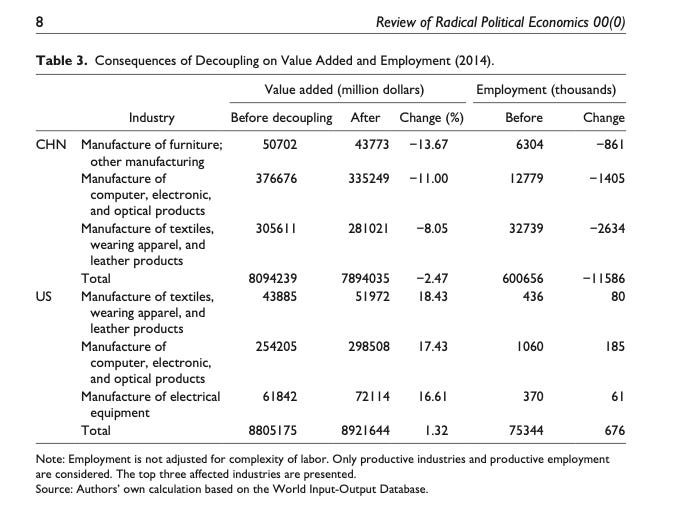
If China doesn’t take proactive measures, the asymmetric costs of allowing America to dictate terms is as follow (emphasis added by me):
“If both parties were to transfer their trade with the other party to elsewhere proportionally, China would see a 2.47 percentage point slowdown in its growth rate which translates into 11.6 million job losses, a stunning magnitude that is enough to destabilize the Chinese society. This pain would be intensely felt in the labor-intensive sectors, e.g., the textiles industries. As for the US, it would gain 1.32 percentage point in its overall growth with 676 thousand more jobs created, though some sectors would suffer from slowdown and job losses.”
The authors concluded:
“the risk of decoupling is an important reason for China to expedite its reduction of trade reliance and propose the new Double Circulation development model…China’s seemingly sharp turn in its development strategy—the new Double Circulation strategy—is essentially an accelerated step in its long-planned restructuring of the economy…The recent strategic acceleration of this transition is motivated by the trade war since the risk of reverse globalization is so huge that China does not want to subject itself to the hostage of imbalanced trade.”
The similarities to Ireland should be clear. In the past, Ireland and China both pursued a globalized trade model focused on American asymmetric relationships. The model was a success but has since become obsolete after reaching advanced development and challenged by a more anxious America. This problem contains real hard constraints that make decoupling from America very difficult in the short-term. Without a proactive long-term vision, passive thinking results in bending to American interests.
China has already chosen to weather whatever storm may come so long as it can get in front of it. China sees it better to take the initiative and deal with any short-term costs because it will be worth it in the long-term. Ireland and China are ships facing rough waters. Ireland has chosen to close its eyes as its ship teeters on top of the tall waves. Inversely, China took the wheel and would rather steer its ship through the waves with the odds in its own hands.
Conclusion
The ideal stance for Ireland would be to take a note from China and implement an Irish “Double Circulation” strategy. Such a strategy would converge with the EuroStack strategy. Ireland could gain from becoming a leading voice for the EuroStack. It’s leadership position could enable favorable distribution of European resources in a EuroStack industrial policy that would build up a truly sovereign Irish tech sector. Ireland already has comparative advantages such as a highly educated population and an existing semiconductor chip industrial footprint (as the second largest exporter of chips behind Germany). Ireland should leverage these strengths and its European partners to build an economy that is no longer asymmetrically dependent on America.
However, that requires a radical change. As this essay reviewed, Ireland’s economic structures create incentives that shape its political choices. The hard constraints shackle Ireland to the short-term status quo no matter how risky it might be in the long-term. It is most probable that the rest of Europe wakes up to its own interests in the multipolar era and begins down the path of the EuroStack and similar policies that remove American competition from Europe and build up European counterparts. Meanwhile, Ireland will kick and scream throughout this process only to ultimately fail in stopping it. Such obstructionist behavior will position Ireland in the back of the line in a future sovereign European economy as European partners either neglect or punish Ireland for its counterproductive behavior.
Although doomed from the start, Ireland’s mutation into an American-centric comprador parody to combat Europe will reward Ireland with the negative effects of economic neoliberalization and altering its indigenous political values. This quagmire would be America’s virtual Vietnam. An unwinnable war with lots of expense only to cut and run once losing is undeniable and leaving behind a ruined country for nothing. Are whatever short-term economic costs there are really worth alienating Europe, sacrificing long-term economic interests, hollowing out the middle class, and turning Ireland’s back on its core cultural values? I don’t think they are worth it.
As Michael Collins said, “Ireland will provide splendid opportunities for the investment of Irish capital, and it is for the Irish people to take advantage of these opportunities. If they do not, investors and exploiters from outside will come in to reap the rich profits which are to be made. And, what is worse still, they will bring with them all the evils that we want to avoid in the new Ireland.”